The Real Reason Your Cylinders Turn Into Bowls
We've all been there. You're two minutes in, the clay feels solid, and you start pulling. Nice and slow. Controlled. Then you blink. Your cylinder shape loss is so bad it could hold soup. What happened? Actually, it started way before you touched the wall. Most beginners think throwing cylinders is about the pull. It's not. It's about everything you did in the first thirty seconds. The compression. The base. The water. Your hands think they're going straight up, but your subconscious is pushing outward. That's the real villain here.
Your Water Addiction Is Sabotaging You
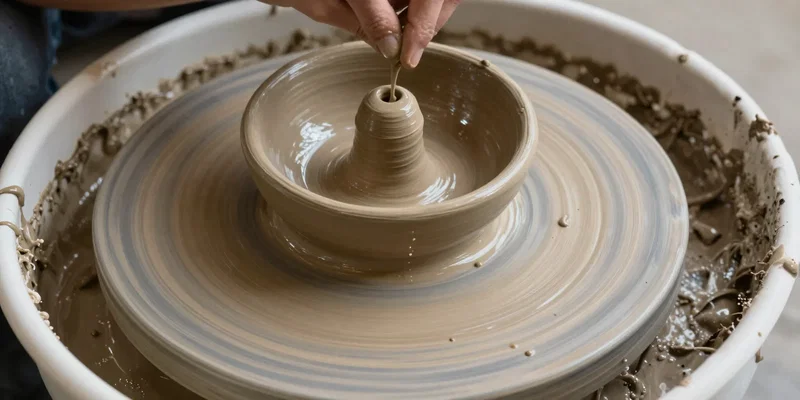
Here's the thing. Water is not your friend. It's a lubricant, sure. But too much of it and you're not throwing clay anymore. You're throwing mud soup. When the base gets saturated, it loses its backbone. The centrifugal force takes over. The bottom spreads. The walls follow. Cylinder shape loss happens because the clay is literally too weak to stand up to gravity. Dry your hands. Use a soft rib. That puddle in your palm? It's a death sentence for pottery form control.
You're Squeezing the Life Out of the Middle
Beginner wheel issues almost always come down to pressure placement. You put your fingers on the side, squeeze, and hope for the best. Hope is not a strategy. When you apply force to the middle of the wall, the clay has nowhere to go but out. It balloons. It becomes a bowl. You need to think like a hydraulic press. Pressure from the inside, support from the outside, moving in a vertical line. Not a hug. A lift. If your knuckles are white, you're doing it wrong.
That Wheel Is Spinning Way Too Fast
Crank that pedal and you feel like a pro. The clay hums. It looks smooth. But actually, speed is a liar. A fast wheel hides flaws until the very last second, then it punishes you. Throwing cylinders requires patience. Slow it down. Way down. You want the clay to tell you where it's thin before it rips. Fast wheels force the clay outward through sheer momentum. You're not shaping it. You're just along for the ride. And the ride ends in a bowl every single time.
You Skipped the Foundation. Again.
Everyone wants to get to the fun part. The pulling. The shaping. Nobody wants to compress the base for five solid minutes. But here's why your cylinder collapses: the bottom isn't one piece. It's got a spiral seam, air pockets, a weak center. You didn't cone up and down enough. You didn't compress with your rib. So when you pull, the base spreads like pancake batter. Pottery form control starts at the floor. Not the ceiling. Get on your hands and knees if you have to. Make that base bulletproof.
Soft Clay Doesn't Owe You Anything
Sometimes it's not you. It's the clay. Maybe you reclaimed it yesterday. Maybe it's summer and the studio is humid. Soft clay is a dream to wedge but a nightmare to throw. It has no memory. No structure. It will betray you the moment you look away. If your cylinder shape loss happens no matter what you do, check your clay body. It should feel like cool, firm flesh. Not pudding. Not butter. Firm flesh. Wedge it longer. Let it sit. Your beginner wheel issues might just be a materials problem wearing your patience down.
Fix It Now: The Rib Is Your Secret Weapon
Stop trying to rescue it with your bare hands. They're clumsy. They lie. Grab a rib. A good one. Metal or silicone, doesn't matter. Hold it against the inside wall and pull the outside with your other hand. The rib enforces the straight line your fingers can't. It corrects the angle. It scrapes off the slurry that's lubricating your collapse. This is how you save a cylinder that's trying to become a bowl. Not by pulling harder. By pulling smarter. Get the tool in there. Save the form. Then throw another one.